
Furnishing a Holiday Let That Actually Pays

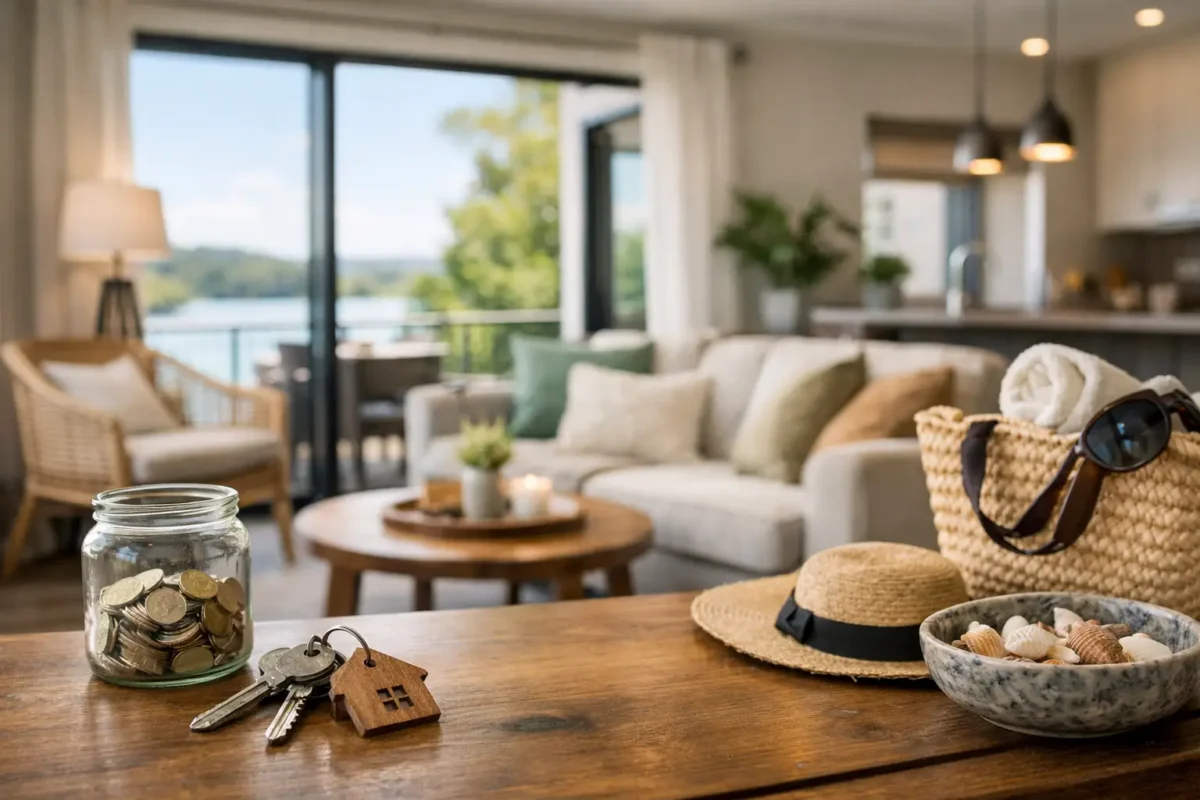
The quickest way to spoil the return on a short-let is to furnish it like your own second home. Guests do not reward your sentiment, and they rarely notice what cost you most. They do notice whether the bed is excellent, the sofa looks tired in six months, and the photographs feel clean, calm and worth the nightly rate. That is the real work in furnishing a holiday let.
If you are letting commercially, every purchase has two jobs. It must survive repeated use, and it must help the property book. Those aims overlap, but not perfectly. The handsome bouclé chair that photographs well may look shabby after one wet season. The cheapest dining chair may survive, but if it makes the room read like student housing, you will feel it in your rate and occupancy. The trick is not to spend more everywhere. It is to spend with intent.
Furnishing a holiday let starts with the nightly rate
Most owners begin with a shopping list. Start with the revenue target instead. A holiday let charging £140 a night needs a different standard of furnishing from one at £420, even if both have two bedrooms and a sea view. Guests are not comparing your furniture to the trade price you paid. They are comparing your listing to the six other properties visible on the same screen.
A useful rule is to set your furnishing budget as a percentage of gross first-year revenue, not as an arbitrary room-by-room spend. For a straightforward UK short-let, 12 to 18 per cent of projected first-year revenue is a sensible starting band. If you expect £60,000 gross, a furnishing budget of £7,200 will feel tight, £9,500 workable, and £11,000 to £12,000 gives you room to buy properly in the places that matter. At the upper end of the market, where photography, finish and guest expectation rise sharply, that ratio often needs to climb.
This is less glamorous than discussing colours, but it stops two common mistakes. One is overspending on visible pieces and underfunding mattresses, window treatments and spare stock. The other is trying to hit a premium rate with a furnishing level that cannot support it.
Spend heavily in three places, then calm down
If you want a holiday let to earn well and age decently, there are three places to protect: beds, upholstery, and lighting. Everything else can be disciplined.
Beds first. In reviews, sleep beats decoration. A proper pocket-sprung mattress from Hypnos, Harrison Spinks or Vispring’s hospitality ranges will do more for repeat bookings than an expensive coffee table ever will. In practical terms, I would rather see £900 to £1,500 spent on a king mattress than the same sum distributed across decorative accessories. Add a washable mattress protector, two pillow weights, and white cotton bedding at 300 to 400 thread count. Percale tends to feel cooler and cleaner than sateen, which matters in summer lets.
Then upholstery. Most holiday lets make the same error here: they buy a pale, fashion-led sofa because it looks expensive online. Six months later, the arms are grey and the seat cushions have collapsed. Use commercial-grade fabrics where you can, or at least tightly woven domestic fabrics with a high rub count. Loose covers are useful only if they are genuinely washable and cut well. Otherwise they become a maintenance story. A sofa in a clever mid-tone, oat, tobacco, olive-grey, forgives real life better than ivory ever will.
Then lighting. One central pendant and two table lamps is not enough. If the property photographs flat, it usually is flat. Build three layers: ambient, task and low evening light. A pair of wall lights either side of a bed reads better than a single overhead fitting. In a sitting room, combine one ceiling source with two lamps at different heights. Guests rarely praise this directly, but they feel it, and the listing photography benefits immediately.
What guests actually read in a room
Guests read a room faster than owners do. In the first few listing photos they are judging three things: cleanliness, scale and ease. That means furnishing a holiday let is partly an exercise in visual editing.
Start with scale. Most rental properties are under-furnished, but not in the way people think. They may contain enough objects, yet the pieces are too small. A 160 x 230 cm rug floating in a living room with a three-seat sofa nearly always makes the room feel cheaper. In most cases, 200 x 300 cm is the minimum useful size if you want the front legs of the seating to sit on it. Curtains should also be fuller and taller than owners expect. Hang the track close to the ceiling and let the fabric finish just off the floor. The room will feel more resolved, and the windows larger.
Then ease. Holiday guests do not want to decipher your storage. Give them obvious luggage stands, decent hangers, bedside charging points and enough hooks in the right places. Four strong bathroom hooks often matter more than a decorative stool. A bench near the entrance saves walls from suitcase scrapes. This is not styling. It is friction removed.
Cleanliness is partly real and partly visual. Matte black taps, glossy dark cabinetry and open shelving full of objects all photograph well on day one, then show every watermark, fingerprint and missed dust line. If your cleaner has a four-hour turnaround, choose finishes that help them win. Warm whites, mid-tone timber, brushed nickel, closed storage and large-format lampshades are your allies.
Choose materials for turnover, not for fantasy
The wrong material can turn a profitable let into a maintenance loop. This is where owners often furnish for an imagined life rather than the actual one.
Dining chairs are a good example. Cane seats look charming and can work in the right house, but they do not enjoy heavy turnover, children climbing, or damp coastal air. A solid ash or beech frame with an upholstered seat pad is usually the steadier choice. If you need the room to read lighter, use the shape, not the fragility, to get there.
Likewise with casegoods. Veneered oak from a reputable maker can be entirely sensible, but very soft timbers, thin metal legs and heavily textured surfaces tend to age badly in short-lets. Better a simple painted bedside with a proper drawer runner than an intricate piece that chips and rattles. Utility is not the enemy of taste. Often it is what allows taste to survive.
If the property is coastal, the rule tightens. Salt air punishes poor finishes. Iron corrodes, cheap chrome pits, timber moves. In the Algarve, the Balearics or any exposed shoreline, use marine-aware exterior pieces where relevant, powder-coated metal rather than untreated steel, and avoid anything that relies on a delicate lacquer. A house near the sea can still feel refined, but refinement there is largely about choosing the battle-tested version.
Give the property one clear identity
A listing that books well usually has a legible point of view. Not a theme, and certainly not a basket of clichés, but a clear visual identity that helps the property stick in the mind.
This does not require theatrical design. It often means choosing one period or one discipline and applying it quietly. A Georgian townhouse let may borrow from English country house restraint: tailored skirts, antique brass, striped runners, off-white walls with a dirtier undertone such as Slaked Lime Mid. A 1970s coastal flat might lean into cleaner lines, woven materials and a restrained walnut palette. The point is coherence.
When everything comes from a different visual language, guests may not know why the place feels uncertain, but they will sense it. A room with a simple Hector Finch wall light, a plain oak console, and one properly framed print usually reads better than a room trying to prove personality with nineteen small things from nineteen sources.
Art matters here, but only if it is scaled correctly. Most holiday lets hang art too high and too small. The centre of the piece wants to sit roughly 145 cm from the floor, adjusted for furniture beneath. Over a king bed, one substantial work or a disciplined pair will outperform a scattered gallery every time.
The numbers should include replacement, not just setup
The furnishing budget is not the whole cost of furnishing a holiday let. You also need a replacement rhythm. That is where many otherwise sensible schemes fall apart.
As a working assumption, I would plan to replace lower-cost occasional furniture and soft goods every two to three years, mattresses every five to seven depending on use, and principal upholstery on a similar cycle if occupancy is high. Buy two sets of removable cushion covers if you insist on cushions. Hold spare bedside lampshades, pillow protectors and dining chair glides. The unit economics are dull, but they save service gaps.
This is also why cheap furniture often turns out expensive. The £129 bedside table that wobbles, chips and needs replacing three times costs more than the £340 one that survives. Commercial readers understand this instinctively in other parts of a business. Furnishing should be treated the same way.
At FurnishIQ.AI powered by Tobias Oliver, that is usually the decision point we come back to: not what looks nicest in isolation, but what standard the property needs to earn credibly, and what will still make sense after a year of guests, cleaners and reorders.
If you are furnishing a holiday let, try this before you buy another thing: write down your target nightly rate, your expected occupancy, and the three guest complaints you most want never to receive. Your furnishing scheme should answer those first. The room can be beautiful afterwards.