
What Size Rug for a Living Room?

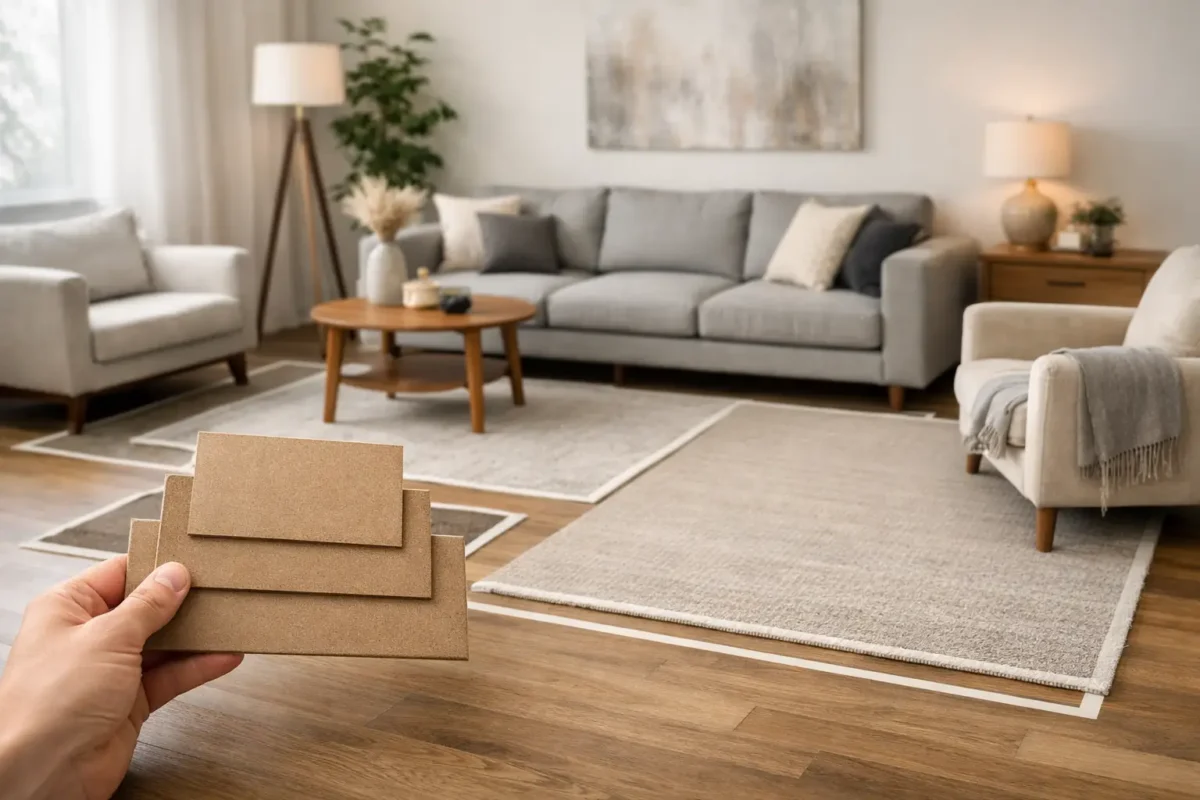
The quickest way to make a living room look meaner than it is, even with good furniture, is to buy a rug that is too small. If you are asking what size rug for a living room, the short answer is this: in most proper sitting rooms, the rug should be large enough for at least the front legs of every main seat to sit on it, and often all legs if the room allows.
That matters because a rug is not decoration in the loose sense. It is the thing that tells the eye where the seating group begins and ends. Get the scale wrong and the room feels as if the furniture is floating. Get it right and even fairly ordinary pieces read as intentional.
What size rug for a living room usually works?
For most living rooms, the safe starting point is 240 x 340 cm or 300 x 400 cm. Smaller than 200 x 300 cm is where many rooms begin to look under-rugged, unless you are dealing with a compact flat, a snug, or a very tight secondary seating area.
A common British mistake is to buy the rug after the sofa and coffee table, then size it to the table alone. That nearly always produces a postage-stamp effect. The rug should relate to the whole conversation area, not just the furniture in the middle.
As a rule, leave roughly 20 to 45 cm of visible floor around the rug edges if the room is enclosed and modest in scale. In a larger room, especially one with generous proportions or an open-plan layout, you can leave more. The point is not to chase a universal border. The point is to make the rug look deliberate in the architecture.
Start with the furniture, not the room
When clients ask what size rug for a living room, they often reach for the room measurements first. I start with the seating layout. The furniture grouping is what the rug must hold together.
If you have a standard arrangement, say a sofa around 220 to 240 cm wide and two armchairs opposite or angled in, a 240 x 340 cm rug is usually the minimum that looks convincing. With a larger sofa, a sectional, or deeper chairs, 300 x 400 cm is often the better answer.
There are three layouts that work.
Front legs on the rug
This is the most reliable arrangement for everyday projects. The front legs of the sofa and chairs sit on the rug, the back legs remain off it, and the coffee table sits comfortably within the field. It gives you cohesion without requiring a truly enormous piece.
In practical terms, this often means a 240 x 340 cm rug in a medium-sized room. If your sofa is 230 cm wide and your chairs are 85 to 95 cm deep, that size usually gives enough landing area without feeling pinched.
All legs on the rug
This tends to look calmer and more generous, especially in larger period rooms or open-plan spaces where the seating group needs proper definition. Think of a broad Edwardian reception room, or a new-build open-plan living area where the rug has to do the work of zoning.
Here, 300 x 400 cm is often right, and sometimes larger. A big rug is expensive, yes, but so is a room that never quite settles. This is one of those purchases where underspending is often false economy.
Only the coffee table on the rug
This is the arrangement to avoid in most main living rooms. It can work in a very small room, or when layered over sisal or seagrass, but on its own it usually makes the seating feel disconnected. If all you can fit is a small rug under the table, you may be better with no rug at all.
Typical living room rug sizes and when to use them
Size guides are only useful if they tell you where they fail. Still, a few real numbers help.
A 160 x 230 cm rug suits a small seating corner, a compact study area within a larger room, or a modest flat where the sofa is around 180 cm and there is little clearance. It is rarely enough for a full family living room.
A 200 x 300 cm rug can work in a smaller living room with a two-seat sofa and one chair, particularly if the room is under about 3.2 x 4 metres. Even then, you need to check that the front legs can sit on the rug without balancing on the edge.
A 240 x 340 cm rug is the standard answer for many grown-up living rooms. It accommodates a three-seat sofa, two armchairs and a coffee table without strain. If you furnish property to sell or let, this is often the size that photographs best because it makes the room look properly grounded.
A 300 x 400 cm rug is what I specify when the room is generous, the sofa is substantial, or the architecture needs a stronger gesture. It is also useful in open-plan rooms where the living zone must be distinct from dining or kitchen areas.
Anything above that becomes project-specific. In some houses, especially wide-plan villas or grand lateral flats, a custom rug is the sensible route. That is not indulgence. It is often the only way to get the scale right.
How much floor should show around a living room rug?
You do not need mathematical purity here, but you do need consistency. A rug shoved close to one wall and miles from another looks like an afterthought.
Aim to keep the rug centred on the seating group, not necessarily centred in the room. That distinction matters. Fireplaces, French doors, deep bay windows and circulation routes often mean the furniture grouping is slightly offset from the architecture. The rug should follow the furniture.
In a rectangular room, run the rug in the same direction as the room and usually parallel with the sofa. In a square room, you have more freedom, but the coffee table and main seating still need to sit comfortably within the boundaries. If the rug edge lands halfway under chair legs or just short of a sofa foot, go up a size.
Shape, material and pattern change the apparent size
This is where rules become judgement. A dark, heavily patterned rug will read smaller than a pale plain one of the same dimensions. A thick wool rug with a strong border, think traditional Oushak or a formal Persian design, visually contains the furniture more tightly than a broad, low-contrast flatweave.
That does not mean plain is always better. It means if you are between sizes, and the rug has a bold border or dense pattern, choose the larger one. Borders effectively shrink the usable visual field.
Material matters too. In a hard-working rental or a coastal property, I often favour wool blends, flatweaves or indoor-outdoor constructions over precious silk mixes. Sisal and jute can look handsome, especially in relaxed schemes, but they are less forgiving under coffee tables and can wear poorly in high-turnover lets. For a formal sitting room, a hand-knotted wool rug from a house such as Jacaranda or a restrained contemporary weave from a maker like Crucial Trading gives enough substance without shouting.
Open-plan rooms need a bigger answer
In open-plan spaces, people often underestimate rug size because they are thinking about furniture rather than zoning. If the living area sits within a larger kitchen-living room, the rug has to define territory.
That usually means going larger than you first think. A sectional sofa in an open-plan room can swallow a 240 x 340 cm rug whole. A 300 x 400 cm size, or a custom dimension, is frequently what makes the arrangement feel composed rather than adrift in a sea of flooring.
There is a commercial point here too. In property photography, a properly scaled rug makes a room read as larger, not smaller, because it clarifies the plan. Buyers and guests respond well to rooms that seem resolved. They may not say, good rug size, but they do register ease.
The easiest way to test what size rug for a living room
Before buying anything, mark the rug out on the floor with painter’s tape. Do not guess. Tape the exact dimensions, place your sofa, chairs and table as they will sit, and check where the legs land.
This takes ten minutes and saves expensive mistakes. It also reveals circulation problems. If the taped rug makes the route to a balcony door awkward, or clips a hearth in a way that looks accidental, you will see it immediately.
If you are choosing between two sizes, the larger one is usually right, provided it does not crash into every edge condition in the room. Small rugs apologise for themselves. Large rugs, within reason, make the room feel thought through.
One final note. If the budget will not stretch to the size the room actually needs, buy a better large rug later rather than a too-small one now. Scale first, then pattern, then pedigree. That order saves more living rooms than any trend ever has.
If you are standing in the room with a tape measure, start by measuring the seating group, not the gap under the coffee table. The answer is nearly always bigger than the shop display suggests.