
How to Furnish a Show Flat That Sells

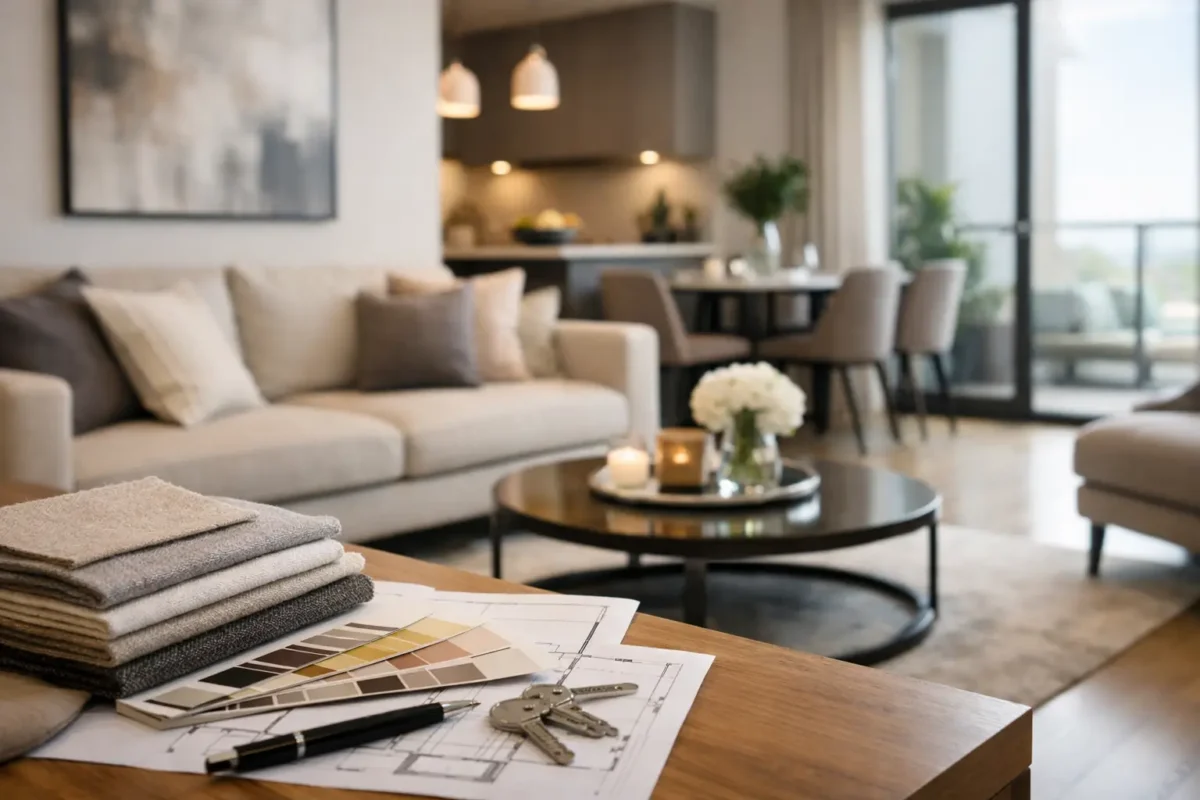
A good show flat is not the nicest flat in the building. It is the one that makes the widest pool of buyers feel immediately at ease, within about 90 seconds of walking in.
That is the real answer to how to furnish a show flat. You are not decorating for applause. You are reducing friction in the sale. Every decision, from sofa depth to bedside lamp height, should help a buyer understand scale, imagine daily life and feel that the property is worth the asking price.
If you furnish it as a private home, you will usually over-style it. If you furnish it like a serviced flat, you will flatten it. The job sits in the middle. A show flat has to read aspirational and believable at once, and it has to survive viewings, photography and the opinions of three different stakeholders before lunch.
How to furnish a show flat starts with the buyer, not the furniture
Before you choose a single chair, decide who this flat is trying to convert. A one-bedroom flat aimed at first-time buyers wants a different emotional temperature from a two-bedroom lateral flat aimed at downsizers. The first may need a sharper sense of utility and value. The second often needs calm, ease and proper circulation around larger pieces.
Developers sometimes ask for a “neutral scheme”, as if neutrality were the goal. It is not. The goal is legibility. The buyer should understand where to put a coffee down, where to charge a mobile phone, whether a king-size bed fits, and whether four people can eat comfortably. Neutral colours can help with that, but beige on its own does not sell flats.
I would usually start with three decisions: the likely buyer profile, the sales price, and the furnishing budget per square metre. For a mainstream UK scheme, you might be furnishing a show flat at roughly £140 to £220 per square metre for furniture, lighting, art and accessories, depending on the target market and how much is being made to measure. Above that, you are usually making a stronger branding play. Below it, you need a very disciplined scheme and a supplier mix that does not look penny-wise.
Set the plan before you set the palette
The fastest way to make a show flat feel wrong is to underscale the furniture. The second fastest is to block the natural route through the room. Buyers do not analyse this consciously, but they feel it at once.
In the sitting room, begin with the rug, not the sofa. In most open-plan developer flats, the rug wants to be larger than instinct suggests. A 200 x 300 cm rug is often the minimum that allows a proper front-leg sit for the seating group. In a larger principal reception space, 250 x 350 cm may be the right answer. A small rug makes a room feel apologetic and makes the flat seem smaller, which is a strange result to pay for.
Then place the sofa with a reason. A three-seat sofa around 220 to 240 cm long suits many show flats because it establishes generosity without swallowing the room. Keep seat depth sensible. Deep lounge sofas photograph well but can read lazy in a sales environment, particularly if the buyer profile is older. A seat depth around 60 cm is often more useful than the sink-in versions that are fashionable for about five minutes at a time.
Dining is where many schemes lose credibility. If the plan says four can dine, prove it. Use a table that actually allows four place settings and chairs that can be moved without a wrestling match. A round table of 100 to 110 cm diameter can be kinder in tighter plans than a rectangle with awkward corners. It also keeps sightlines open in photography.
Bedrooms need the same honesty. If the room takes a 150 cm king-size bed, use one. Do not squeeze in a bed that leaves 35 cm on either side and then pretend it is practical. You want at least 60 cm clearance where possible, enough for a bedside table and an adult to move normally. A buyer may not bring a tape measure, but they do bring judgement.
Give the flat one clear idea
When people ask how to furnish a show flat, they often mean what style it should be. The answer is simpler than style. Give the flat one coherent point of view, then repeat it quietly.
That might be soft contemporary with pale oak, brushed brass and warm whites. It might be a slightly more architectural scheme with blackened metal, walnut and limestone tones. What matters is consistency of language. If the living room says pared-back Belgian and the bedroom says mid-century hotel, the flat feels assembled by committee.
A restrained scheme usually outperforms a characterful one in sales terms because it leaves room for projection. That does not mean bland. It means one lead note and careful control of contrast. Think walls in a soft broken white, upholstery in oat, stone and tobacco, a little black for line, and timber with visible grain. If you want a named reference, the discipline of John Pawson is more useful here than the exuberance of a maximalist townhouse. Buyers need clarity more than personality.
Art should support the architecture, not start a debate. Large-scale abstract work is often safer than figurative pieces because it creates finish without narrowing taste. Hang it lower than most people do. The centre of the composition wants to sit around 145 cm from finished floor level in most domestic rooms. Higher than that, and the art begins floating above the furniture like an afterthought.
Spend where the buyer looks longest
Not all pounds work equally hard. In a show flat, the visible surfaces and touch points do most of the selling.
Spend properly on the sofa fabric, the bed upholstery, the dining chairs and the lamps. These are close-contact items. Buyers inspect them at arm’s length. If the cloth pills, the stitching pulls or the lamp shades are mean, the whole scheme feels cheaper than it is.
Casegoods can often be simpler. A well-proportioned oak veneer bedside from a reliable maker will usually do more for the room than a fussy statement chest. The same goes for occasional tables. Form and finish matter more than design theatrics. I would rather use a clean-lined table with a decent weight and a stone top than an attention-seeking piece that dates before the first phase is sold.
Window treatments deserve more discipline than they usually get. Ceiling-fixed curtains, set as close to the perimeter as practical, make the room feel taller and more resolved. In a show flat, I often favour a ripple-fold sheer where privacy allows, with a lined curtain in the bedroom if blackout is needed. Short, skimpy curtains are one of the most efficient ways to make a new-build feel ordinary.
Lighting is another place where budgets are often misread. One decorative ceiling fitting per room is not a lighting scheme. Layer it. A floor lamp by the seating, bedside lamps or wall lights at a sensible reading height, and warm bulbs at 2700K will do more for atmosphere than an expensive pendant trying to solve every problem alone.
Make it photograph well, but live better
A show flat is viewed first through a lens and then in person. These two experiences need different things.
For photography, you need depth, tonal contrast and enough negative space for the architecture to read. That means editing accessories hard. Three objects on a coffee table are usually enough. Beds should be full but not over-dressed. Cushions should support the palette, not stage a department store coup.
For viewings, the flat has to feel physically comfortable. Chairs need proper sit height. Side tables need to land near the arm of the sofa, not 40 cm adrift because the stylist wanted a cleaner shot. Mirrors should bounce light, yes, but they should also be placed where a person might realistically use them. The room must survive contact with reality.
This is where a little dryness helps. If an accessory cannot survive an estate agent moving it twice a day, or a buyer’s child picking it up, it probably should not be there. Show flats are commercial tools. Fragility is expensive.
The details that quietly close the gap
The last 10 per cent is where a show flat begins to feel credible. Match metal finishes within sightlines. Keep timber tones to one or two families. Use identical lamp colour temperatures throughout. Make sure the bed linen has enough weight to drape properly. A 200-thread-count cotton can look thin under sales lighting; a good cotton sateen or washed cotton with more body often reads better.
Books matter too, though not in the silly stacked-by-colour way. A few well-chosen hardbacks on design, travel or architecture make more sense than performative clutter. The same principle applies to kitchen dressing. A chopping board, a bowl, perhaps a carafe. Not a fruit market.
And if the property is coastal, very bright or overseas, adjust accordingly. Algarve light, for instance, strips weakness from materials and exaggerates yellow undertones. What reads as warm white in London can look stale there. Sun, salt and short-let wear also punish cheap finishes. In those contexts, powder-coated metals, performance fabrics and less porous surfaces are not a style preference but basic self-respect.
If you are working out how to furnish a show flat, keep the brief narrow. Prove scale. Remove doubt. Give the buyer a life they can step into without feeling managed. That is usually enough. If you need a useful next step, cost the scheme room by room before you look at pictures. The arithmetic is where good furnishing starts.